This year’s Action for Brain Injury Week campaign, fronted by BBC The Traitors star, Andrew Jenkins, shines a light on the reality that brain injury can happen to anyone at any time.
On the BBC show, Andrew Jenkins shared his personal experiences of brain injury sustained in a road traffic collision in 1999. In the weeks that followed the crash, Andrew died, was in a coma, had a stroke, had titanium plates fitted into his head and caught the killer bug MRSA. There were many times he wasn’t expected to survive, and Andrew was also told he would never walk again. Andrew defied the odds and has found a new purpose in sharing his inspiring story with others.
Brain injury changes life goals, throws plans into disarray and can take away someone’s sense of who they are.
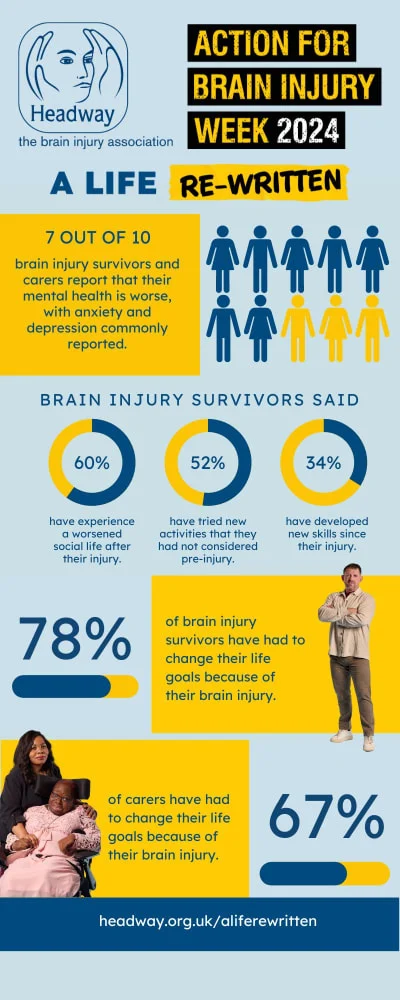
Research by national charity, Headway – the brain injury association reveals that more than three quarters of people with brain injuries (78% of survey respondents) have had to change their life goals as a result of the consequences of their brain injuries. Examples of the types of goals that have had to change include:
- Career prospects
- Retirement plans
- Sports and hobbies
- Undertaking further studies
- Getting married or having children
- Travelling
- Home ownership
Developing new skills after brain injury
Around a third of respondents with brain injuries (34%) have developed new skills since their injury.
Various types of skills were reported, including:
- Coping skills to manage the effects of brain injury, such as being able to monitor behaviour and using breathing exercises;
“I’ve worked hard to learn new skills to counter-balance my behaviours and impulses to control them and to be more socially acceptable.”
- Positive personal traits including perseverance, empathy, kindness, confidence and a greater appreciation of life;
“I have a glass-half-full outlook now, and I am more optimistic.”
- Daily living skills, with many survivors specifically describing new cooking skills;
“New work skills and qualifications, knitting as I mentioned earlier, basic baking, I make a mean Victoria Sponge now!”
- Recreational skills, with a wide range of hobbies described including art, sewing, gardening and sports;
“Learning to play piano. New gardening techniques.”
- Educational/vocational skills, assisting with career prospects.
“Since my brain injury and first-hand experience of feeling a complete loss of personal power (and losing my job) I have retrained as both a teaching and learning assistant in schools and am now a registered member of the British Association of Counselling and Psychotherapy having taken a diploma in therapeutic counselling.”
52% of respondents with brain injuries have tried new activities since their brain injury that they had not considered before their injury. For information on Headway Nottingham’s rehabilitation activity timetable contact us on 0115 9679669 or make a referral for our support.
Social life after brain injury
60% of respondents with brain injuries experience a worsened social life after their injury.
Reasons given for social life being worse included the following:
- Struggling with the effects of brain injury in social environments, such as anxiety, overstimulation and concentration difficulties.
“I struggle in social situations due to anxiety and sensory overload.”
- Fatigue affecting energy levels to socialise.
“I don’t have the stamina that I once had and the fatigue really kicks in regularly, hence I don’t do or go to half the things I used to.”
- Friends failing to understand or accommodate for the effects of brain injury.
“I struggle in public and have lost friends because they don’t understand the new me.”
- Friends no longer staying in touch or including the survivor in social activities.
- Being unable to remember social events.
- Socialising being a different experience due to no longer drinking alcohol.
- A lack of interest in socialising any longer.
- Practical issues with socialising, such as being unable to drive, work taking priority, fear of stigma and having less money.
“Better in that I have more friends but worse in that I can’t afford to do as much anymore.”